
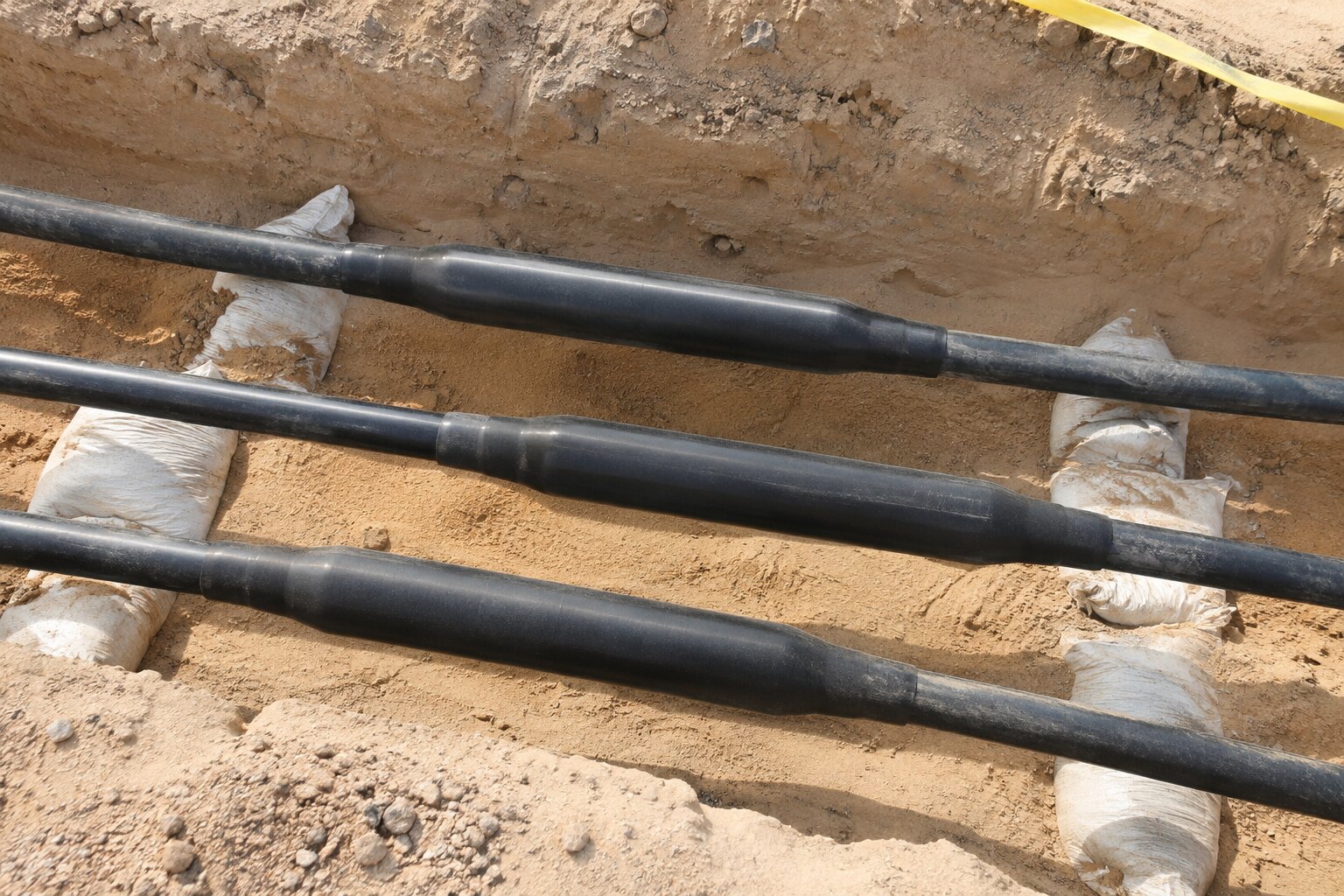
- Most joint failures are workmanship failures: screen removal, contamination, dimensions and connectors.
- Passing an insulation resistance test does not prove a joint is sound. Small defects cause partial discharge that erodes the insulation over time.
- The controls are a certified jointer, the correct kit, the correct tools, a clean and dry work area, and the kit's dimensions followed exactly.
- A joint record with the jointer's name, kit batch, location and photographs makes every joint traceable.
Where joints go wrong
In an XLPE cable the electric field is controlled by smooth semi-conductive layers on both sides of the insulation. A joint has to remove those layers, connect the conductors and rebuild the field control. Each step has a typical error.
- Removing the insulation screen. A knife cut that nicks the insulation, a ragged screen edge, or traces of semi-conductive material left on the insulation surface all concentrate the electric field.
- Contamination and moisture. Dust, sand, sweat or damp on the prepared insulation ends up sealed inside the joint.
- Dimensions. Each kit gives cut-back lengths for its stress-control components. A joint made by eye places them in the wrong position.
- The connector. The wrong size, the wrong die, an incomplete compression, or shear bolts not taken to shear leaves a high-resistance connection that overheats under load.
- The wrong kit. A kit must match the voltage class, conductor size range and cable construction.
- Shrinking. Uneven heating of heat-shrink tubes leaves voids; a cold-shrink body released off position does not cover the screen cut.
- Screen and armour continuity. A poor bond across the joint interrupts the earth path and the fault-current return.
- Sealing and bedding. Water entering through a poor outer seal, or a joint bent or unsupported in the trench, fails mechanically first and electrically second.
Why a joint passes its test and fails later
A small void, a nick or a contaminated surface does not short-circuit the cable. It creates partial discharge, a tiny repeated spark inside the defect, which erodes the insulation until it punctures. This is why an insulation resistance reading taken after jointing can be good while the joint is already on its way to failure, and why owners specify withstand tests, and on important circuits partial-discharge or tan-delta measurement.
What prevents it
- Jointers trained and certified on the kit type, and accepted by the network owner where it requires this
- Screen-stripping and insulation-preparation tools in place of knives
- A tent or cover over the joint bay, a dry pit, and clean hands, cloths and solvent
- The kit instruction sheet open at the joint, with every dimension measured
- The correct connector and compression die, or shear-bolt connectors taken to shear
- A joint record: jointer, date, location, cable details, kit type and batch, with photographs at the stages the owner specifies
- Tests after jointing as the specification requires, before backfilling where possible
What to ask a jointing contractor
- Which kit types and voltage classes are your jointers certified for, and by whom?
- Will the same named jointers be on my site?
- Can I see a completed joint record from a previous job?
- What test equipment do you bring, and what do you test before energising?
Where ETC fits
ETC carries out LV and MV cable jointing and termination with its own jointers and test equipment, and issues a record for every joint. The same crews pull the cable and prepare the joint bays, so the joint is not made on a cable damaged during installation.